WOMEN’S RIGHTS - By this summer, the U.S. Supreme Court will issue a decision on the most consequential challenge to Roe v. Wade since the landmark ruling in 1973 guaranteed the constitutional right to obtain an abortion.
If, as legal experts expect, federal abortion protections are eliminated or severely weakened — Politico published a leaked first draft of a majority opinion by Justice Samuel Alito gutting Roe — a cascade of absolute bans will follow in more than a dozen states. Already, six more states are considering so-called “trigger bans” in the lead-up to this summer’s decision, while dozens of other state legislatures are considering 15-week bans, abortion pill bans and bans modeled after Texas’ controversial law that allows private citizens to sue anyone who helps someone obtain an abortion after six weeks.
California lawmakers intend to buck the trend. Democratic Gov. Gavin Newsom aims to make the state a “sanctuary” for out-of-state abortion seekers — even proposing to use state funds to defray their travel costs. He’s already signed into law a measure eliminating out-of-pocket costs for Californians. The state Legislative Women’s Caucus has also introduced a 13-bill package to further cut barriers to access and protect patient and provider rights, and many of those are advancing through the Legislature.
But the state wasn’t always a bastion for reproductive choice. It took decades of black market abortions, a national rubella epidemic, an international drug scandal, several high-profile trials against physicians, and thousands of maternal deaths for California to decriminalize abortion. In fact, abortion remained illegal here until 1967, when state lawmakers passed the Therapeutic Abortion Act. It was signed into law by then-Gov. Ronald Reagan — surprisingly the same politician who later, as president, championed a constitutional “right-to-life” amendment.
In the ensuing years, California has garnered the distinction of being the state that goes furthest to allow easy access to abortion. So how did we get here?
California guarantees the right to abortion in statute and the state constitution. It covers the cost of abortion for lower-income Californians on Medi-Cal, and also requires private insurance to cover it. And the state has rejected the idea of requiring waiting periods or parental consent for abortion.
Here’s how its abortion policies compare to the rest of the country, based on a 12-point scale developed by The Guttmacher Institute.
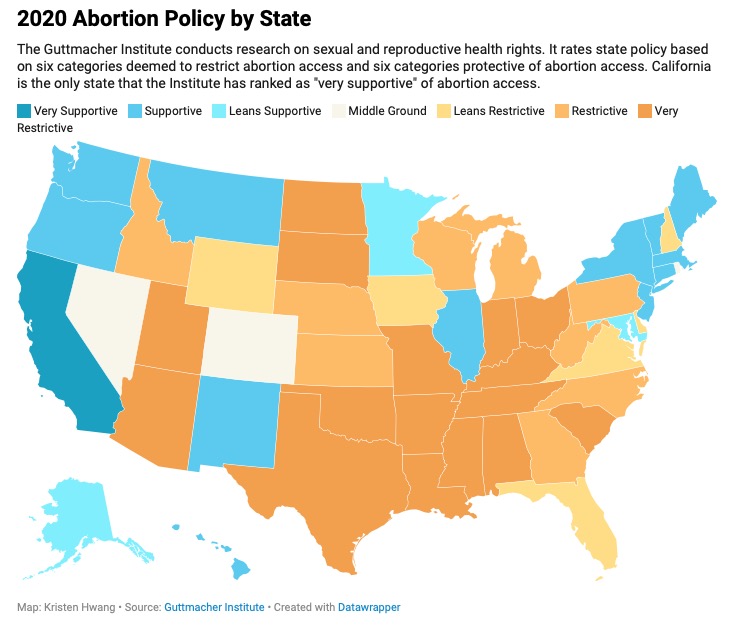
Note: The Guttmacher Instititute was established as part of Planned Parenthood in 1968 but sought independent status roughly 10 years later and stopped taking financial contributions from Planned Parenthood more than a decade ago. Here are the 12 criteria for assessing state abortion policies:
Supportive
- Guaranteed in the state constitution
- Guaranteed in state statute
- Guaranteed Medicaid coverage
- Advanced practice clinicians like nurse practitioners allowed to perform
- Private health insurance coverage required
Restrictive
- Pre- or Post-viability abortions banned
- Require in-person counseling and a waiting period
- Medicaid coverage restricted
- Telemedicine consultations prohibited
- Parental consent required
- Clinic regulations imposed like necessitating hospital admitting privileges
California’s abortion laws today:
When does California guarantee the right to abortion?
- If the fetus cannot survive outside the womb, a pregnant person can seek an abortion for any reason.
- After viability, only if continuing the pregnancy threatens the life or health of the pregnant person.
When is a fetus considered viable?
- It's up to a physician's "good faith medical judgement" — in practicality, most doctors consider a fetus viable at 24 weeks or once a fetus weighs 500 grams.
Can someone refuse to provide an abortion?
- Yes, individual medical professionals can, but someone seeking an abortion may request another provider.
- Only religious non-profit hospitals and clinics can have blanket bans.
Do minors require parental consent to get an abortion?
- No. Case law in California established that minors may obtain an abortion without parent or guardian consent.
(Kristen Hwang reports on health care and policy for CalMatters where this story was featured.)